
Falkland Islands Government Invites Rachel Bigsby for Month-Long Seabird Photography Assignment
Award-winning wildlife photographer and seabird conservation advocate Rachel Bigsby was invited by the Falkland Islands Government to undertake a month-long photographic and documentary assignment exploring the extraordinary natural heritage of the South Atlantic archipelago.
Spanning remote islands, internationally important seabird colonies and conservation initiatives, the collaboration brought together Rachel's distinctive fine-art photography, documentary filmmaking and environmental storytelling in an ambitious project titled My Falkland Island Fairytale. The assignment sought to communicate the remarkable biodiversity of the Falkland Islands while celebrating the scientific expertise, community dedication and long-term conservation work that help protect one of the world's most significant seabird environments.
For Rachel, whose life and career have been shaped by seabirds, the visit represented an extraordinary opportunity.
“The Falkland Islands were somewhere I had dreamed of visiting since I was a young girl, long before I could have imagined making a career from my love of seabirds. To be invited by the Falkland Islands Government to spend a month documenting their extraordinary wildlife was an immense privilege. But what stayed with me most was not simply the abundance of seabirds. It was the dedication of the people working to protect them. I wanted this project to celebrate both, because the future of these remarkable islands depends upon that relationship.”
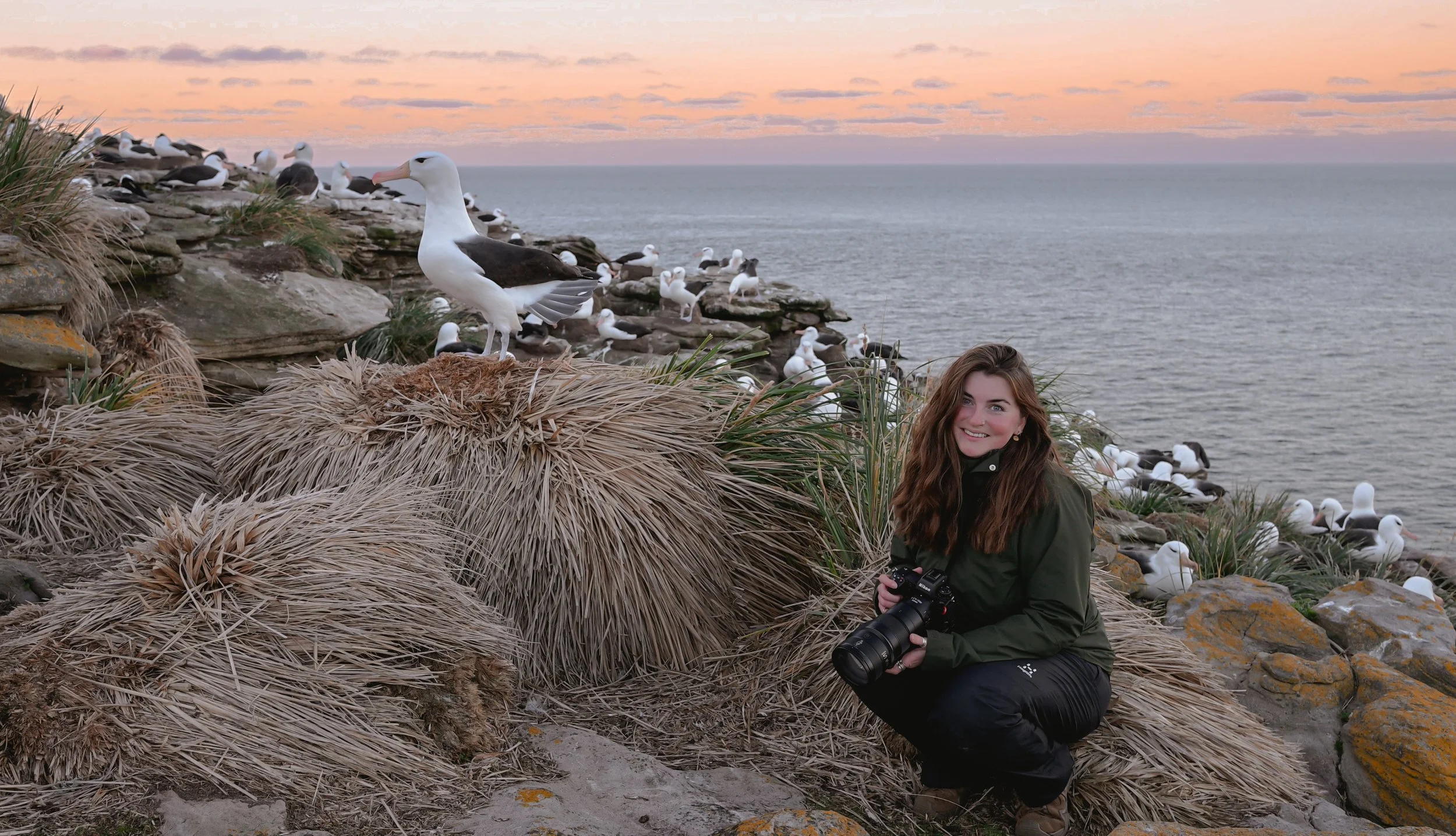
Rachel Bigsby sits among Black Browed Albatross on New Island, Falkland Islands.
A Month Among the Seabirds of the South Atlantic
Situated in the South Atlantic Ocean, the Falkland Islands support extraordinary concentrations of seabirds, including Black-browed Albatrosses, Southern Rockhopper Penguins, King Penguins, Gentoo Penguins, Imperial Shags, Sooty Shearwaters and Southern Giant Petrels.
Throughout the month-long assignment, Rachel travelled between islands and wildlife colonies, working in changing weather conditions to create a photographic collection that would capture both the abundance of wildlife and the distinctive character of the archipelago.
On Sea Lion Island, she documented the elemental relationship between life and death, observing Southern Elephant Seal births and the vital ecological role of Giant Petrels.
Bleaker Island offered an altogether different spectacle, with Southern Rockhopper Penguins engaged in courtship and vast gatherings of Imperial Shags returning to their evening roosts.
At Volunteer Point, Rachel spent two nights among King Penguins, witnessing the extraordinary contrasts of the Falklands' weather and the intricate movements of wildlife across the open landscape.
On Kidney Island, more than 200,000 Sooty Shearwaters returned from the ocean at dusk, filling the sky in an immense procession of wings.
Each location offered an opportunity to explore the islands through Rachel's characteristic artistic approach, combining intimate observation of natural behaviour with an appreciation of light, movement, atmosphere and the wider landscape.
Rather than simply recording the abundance of wildlife, her ambition was to create images that communicated the experience of being there: the isolation, the wind, the immense scale of the ocean and the extraordinary privilege of encountering seabirds in such numbers.

Black Browed Albatross resting on its nest.
The Albatrosses of New Island
Among the defining chapters of the assignment was Rachel's time on New Island, where she lived off-grid among sweeping coastal landscapes, turquoise bays and towering cliffs occupied by Black-browed Albatrosses.
Home to a colony of more than 13,000 Black-browed Albatrosses, the island provided an exceptional opportunity to document one of the Southern Ocean's most captivating seabirds.
Here, Rachel immersed herself in the intimate rhythms of colony life, observing the elaborate reunions of bonded pairs, the careful incubation of eggs and the effortless flight of Albatrosses departing from the cliffs into the open ocean.
The experience allowed her to develop a photographic narrative rooted in the relationship between seabirds and their environment, portraying the extraordinary elegance of these birds against the immense landscapes of the South Atlantic.
For a photographer whose work has long explored the artistic possibilities of seabird behaviour, New Island became a particularly meaningful setting in which to develop her fine-art practice.
The resulting photographs form a central part of My Falkland Island Fairytale, celebrating the extraordinary beauty and natural history of a species whose future remains closely connected to the health of the world's oceans.

Conservation Behind the Abundance
Beyond the photographic collection, conservation formed a fundamental part of the commission.
Working alongside Falklands Conservation and local scientific, veterinary and biosecurity teams, Rachel documented the extensive work undertaken to protect the archipelago's wildlife and habitats.
Her time in the field provided insight into seabird population monitoring, habitat management, invasive species eradication and the continued vigilance required to safeguard vulnerable island ecosystems.
She also accompanied biosecurity teams and detection dogs, witnessing the practical measures employed to prevent invasive predators from reaching protected islands.
Conversations with scientists and veterinary professionals explored the wider challenges facing seabirds, including climate-driven environmental change and the threat of highly pathogenic avian influenza.
These encounters offered an important perspective on the relationship between the Falklands' remarkable biodiversity and the people working to secure its future.
The assignment therefore became as much a portrait of conservation stewardship as it was a celebration of wildlife.
Through photography and film, Rachel sought to communicate not only the extraordinary seabird populations that make the Falklands internationally significant, but also the sustained commitment required to protect them.

Rachel leads a wildlife photography workshop with the Falklands Conservation Youth Group at Volunteer Point
Sharing Photography with the Falklands Community
An important dimension of the commission extended beyond the creation of photographs and film.
Throughout her stay, Rachel participated in a programme of public engagement and educational activities, sharing her experiences as a wildlife photographer and conservation advocate with audiences across the islands.
She delivered presentations at Mount Pleasant Military Base and a sold-out public cinema event, visited Tussock House Retirement Home and a local primary school, and led a youth photography workshop with the Falklands Conservation Youth Group at Volunteer Point.
A public photographic walk also provided an opportunity for local residents to explore their coastline through a different creative perspective, encouraging participants to observe familiar wildlife and landscapes with renewed curiosity.
For Rachel, whose own photographic journey began as a self-taught teenager, these encounters were an especially meaningful part of the assignment.
They reflected a belief that wildlife photography can provide an accessible way for people of all ages to connect with nature, develop creative confidence and appreciate the remarkable environments around them.
My Falkland Island Fairytale
The resulting project, My Falkland Island Fairytale, brings together a substantial photographic collection and long-form documentary exploring the seabirds, landscapes, conservation work and communities of the Falkland Islands.
Combining Rachel's signature fine-art approach with documentary storytelling, the work offers an intimate interpretation of the archipelago that extends beyond conventional destination photography.
It is a portrait of a place defined by the ocean and its wildlife, but equally by the scientists, conservationists and local communities whose dedication helps protect it.
The collaboration demonstrates the possibilities of immersive, conservation-led visual storytelling, bringing together artistic expression, environmental education and a deeper understanding of place.
Reflecting on the experience, Rachel said:
“I arrived with a childhood dream. I left with profound respect — for the seabirds, the science, and the people who protect this place.”